Showing posts with label Double Indemnity. Show all posts

Saturday, May 7, 2011

Best 10 Films of Billy Wilder

Wilder juggles the three Oscars he won for The Apartment

Billy Wilder (born Samuel Wilder) was a newspaper reporter in Vienna in the 20's, then later Berlin, and began writing screenplays in 1929, which he did until Hitler came to power in 1933. With Jewish ancestry, he fled to Paris to escape the Nazis, then came to the U.S. He first started as a screenwriter, penning the famous Garbo film Ninotchka. With Double Indemnity in 1944, which he also wrote, he joined the ranks of directors with a film that many consider was the birth of film noir.

Wilder himself was nominated for 21 Oscars®, winning six, three for screenplay (Double Indemnity, Sunset Boulevard, The Apartment), two for directing (Lost Weekend, The Apartment), one for producer of a best picture (The Apartment). Overall, Wilder won 48 awards out of 95 nominations.
  1. Sunset Boulevard (1950, bw) 9.2 No. 31 on IMDB 250 Three Oscars®, 16 awards overall
  2. Double Indemnity (1944, bw) 9.0 No. 53 on IMDB 250 7 Oscar® nominations, 0 wins
  3. Stalag 17 (1953, bw) 8.6 No. 209 on IMDB 250 1 Oscar®, actor for William Holden
  4. One, Two, Three (1961, bw) 8.8 (comedy) 1 Oscar® nomination, 5 others, 0 wins
  5. Some Like It Hot (1959, bw) 8.4 (comedy) No. 81 on IMDB 250 1 Oscar®, 11 awards overall
  6. The Apartment (1960, bw) 8.4 No. 91 on IMDB 250 Five Oscars®, 22 awards overall
  7. Witness For the Prosecution (1957, bw) 8.3 No. 129 on IMDB 250 Six Oscar® nominations, no wins, 6 awards overall
  8. The Seven Year Itch (1955) 8.2 (comedy) One award, Golden Globe for Tom Ewell, best actor
  9. Ace in the Hole (1951, bw) 8.1 Two awards Int'l Film award for Wilder at Venice
  10. The Fortune Cookie (1966, bw) 7.8 (comedy) Three awards, best supp. actor Oscar® for Walter Matthau
  11. The Major and the Minor (1942, bw) 7.6 (comedy)
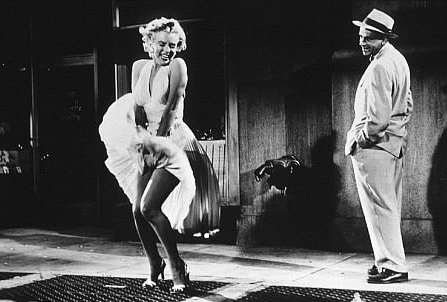
There is no more iconic image in all of cinema than
Marilyn letting the air blow up her dress in The Seven
Year Itch, nor a more copied one, as it's
been often repeated by others

The Lost Weekend should probably be on this list, but I find it so depressing that it's hard to recommend. But it did win the Oscar® for best picture, director (Wilder), and screenplay (Wilder and Charles Brackett), in 1946, for his first two academy awards.

Wilder's Oscar® nominations for picture (as producer):  The Apartment [AA]

Wilder's Oscar® nominations for director:  Double Indemnity, The Lost Weekend [AA], A Foreign Affair, Sunset Boulevard, Stalag 17, Sabrina, Witness For the Prosecution, Some Like It Hot, The Apartment  [AA]

Wilder's Oscar® nominations for screenplay: Ninotchka, Ball of Fire, Hold Back the Dawn, Double Indemnity, The Lost Weekend  [AA], A Foreign Affair, Sunset Boulevard [AA], Ace in the Hole, Sabrina, Some Like It Hot, The Apartment  [AA]


Looking at that list of screeplays, he could have easily won 2-3 more Oscars - Ninotchka, Ball of Fire, Double Indemnity, Sunset Boulevard, Ace in the Hole, Some Like It Hot are all Oscar worthy to me.

Saturday, August 23, 2008

Double Indemnity and the Birth of Film Noir

Double Indemnity (1944) was Billy Wilder's first serious film, and is given credit for the birth of film noir, literally "night film", which describes a visual style and mood of a type of dramatic film, usually crime, that's much more gritty and realistic than most films prior to this era.

Film noir was mostly shot at night or in dark interiors; there's lots of use of shadows, dimly lit edges, light from Venetian blinds (which simulates bars across characters), backlit smoke (Indemnity uses both cigars and cigarettes, Out of the Past is a tribute to cigarettes, each star is always smoking onscreen, especially when it gets tense).

Film noir got its origins in 30's detective stories, often called pulp fiction, gritty stories with sex, violence and seedy characters. Even the heros were often common people with street wisdom, often with a tough upbringing. Soldiers returning from World War 2 and a cinematic audience that had survived the Great Depression demanded more adult films in theme, subject, and style.

Wilder was impressed by author John Kain's pulp novella of "Double Indemnity", the same author of The Postman Always Rings Twice, but it was considered unfilmable due the the Hayes Code (of censorship). The script went through years of re-writes and applications before being allowed to be filmed in 1944. The Hayes Code first suppressed sex in films, then violence, later socialism, and was used to pass judgment on over 28,000 works of art! Apparently no freedom of the arts exists, just more minor ones that don't affect as many people, such as the press (who reads?) Wilder then had a difficult time casting the lead parts, two murdering adulterers.

He wanted Barbara Stanwyck all along, but eventually had to challenge her to get her to take the image-shattering role, "are you an actress or a mouse?" After several refusals by actors, including George Raft, who had a knack for turning down breakthrough parts like Sam Spade in The Maltese Falcon, he convinced Fred McMurray to break his screen image of light romantic comedies to attempt something serious. His first scene with Stanwick, when he meets her at her home in a towel, uses his comedic skills along with some terrific dialogue.

Wilder also convinced leading actor Edward G. Robinson to take a non-starring character role, meaty enough for at least two important speeches that Robinson absolutely nailed. Crime novelist Raymond Chandler (The Big Sleep, The Long Goodbye) was brought in for his realistic dialogue, plenty evident here especially the opening scenes between Stanwyck and McMurray, but he, an introvert, and Wilder, an extrovert, didn't get along at all and never worked together again. Ironically,they were nominated for an Oscar together for their screenplay. Wilder later used Chandler as his model for his Oscar-winning Best Picture The Lost Weekend.

Double Indemnity was nominated for these 7 Oscars (but won none):
  • BEST MOTION PICTURE - Paramount (Going My Way won!)
  • DIRECTING - Billy Wilder
  • ACTRESS - Barbara Stanwyck
  • CINEMATOGRAPHY (Black and White) - John Seitz
  • WRITING (Screenplay) - Billy Wilder, Raymond Chandler
  • MUSIC (Music Score of a Drama or Comedy) - Miklos Rozsa
  • SOUND RECORDING - Paramount Studio Sound Dept, Loren L. Ryder, Sound Director

Other classic film noir: Out of the Past, The Night of the Hunter, Panic in the Streets, D.O.A., The Postman Always Rings Twice, The Big Sleep, The Maltese Falcon, The Third Man.

Modern Noir: Wait Until Dark, Diva (France), Chinatown, Shoot the Piano Player (France), House of Games, Taxi Driver, Blood Simple, Body Heat, The Silence of the Lambs. The style is also clearly evident in parts of other classic films such as In the Heat of the Night, The Godfather, Batman, Who's Afraid of Virginia Woolf, The Hustler, and The Departed.

Thanks to Beth G for suggesting Double Indemnity